
AI isn’t the next internet. It’s a new layer of work.
When the internet arrived, it changed almost everything about speed, but not much about substance.
We moved from letters to email, paper files to shared drives, in-person meetings to video calls. Business became more connected and more measurable. In other words, we changed the car we were driving. It became more comfortable, smoother, faster, more efficient but the fundamentals of the car, and who drove it, remained the same.
People still did the driving.
Decisions still sat with humans. Judgement still lived in meetings. Creativity still depended on brains, not bandwidth. Even when work went “digital”, it was largely a translation of what already existed, faster, cheaper, more scalable, but recognisably the same.
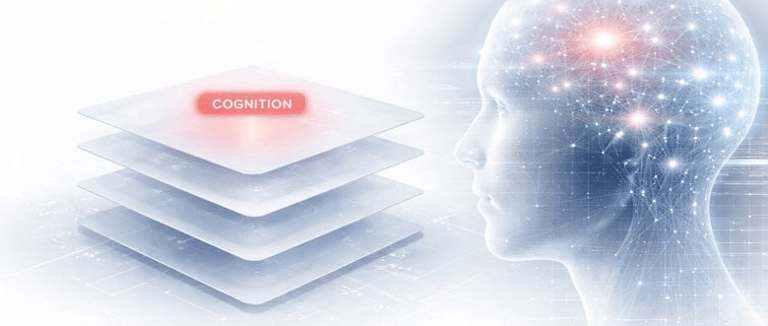
Artificial intelligence is different. Not because it is impressive (it is), but because it touches the part of the system we historically assumed was non-transferable: cognition.
For decades, organisations were built around a central constraint: human thinking is scarce. It is expensive, slow, inconsistent, and dependent on context and experience. That is why we built layers, approvals, committees, governance processes, specialist functions, and review cycles. These weren’t just cultural habits, they were structural responses to a reality: you needed people to interpret, decide, write, analyse, diagnose and persuade.
AI introduces something new. It doesn’t merely move information from A to B. It can generate, synthesise, evaluate, draft, reframe and simulate. In other words, it can do a significant portion of what professional work has traditionally been about.
That doesn’t mean humans are obsolete. It means that work changes shape.
The most useful way to think about AI is not as another tool in the toolbox, but as a new layer in the operating system. The internet reduced the cost of communication and coordination. AI reduces the cost of reasoning, drafting, sense-making and iteration. This is a massive change, one which has implications well beyond simply productivity.
And when thinking becomes cheaper, the organisation’s design starts to wobble.
If analysis can be done in minutes rather than weeks, what happens to the planning cycle? If a first draft is instant, what happens to the role of the person who used to produce it? If leaders can stress-test scenarios on demand, what happens to governance and the Board, how do they evolve? If a team can do the work of two, what happens to structure, spans of control, and career paths?
This is where many organisations are most exposed, because they try to treat AI like a technology deployment. They ask: which tool should we buy, what policy should we write, where can we automate?
Those are not wrong questions, but they are not the strategic ones. They will not, on their own, help an organisation differentiate itself.
The larger question is: what work should remain distinctly human and what work can be safely and responsibly delegated to AI?
That is not a technology conversation. It is a business model conversation, an organisational design conversation, and a leadership conversation.
There is a second part to this blog where I explore why this shift doesn’t just change processes, it changes economics, status, identity, and responsibility. And why the leaders who do best won’t be the ones who “use AI the most”, but the ones who redesign work and deploy AI most intelligently.